Valentines Kingdom · Book One
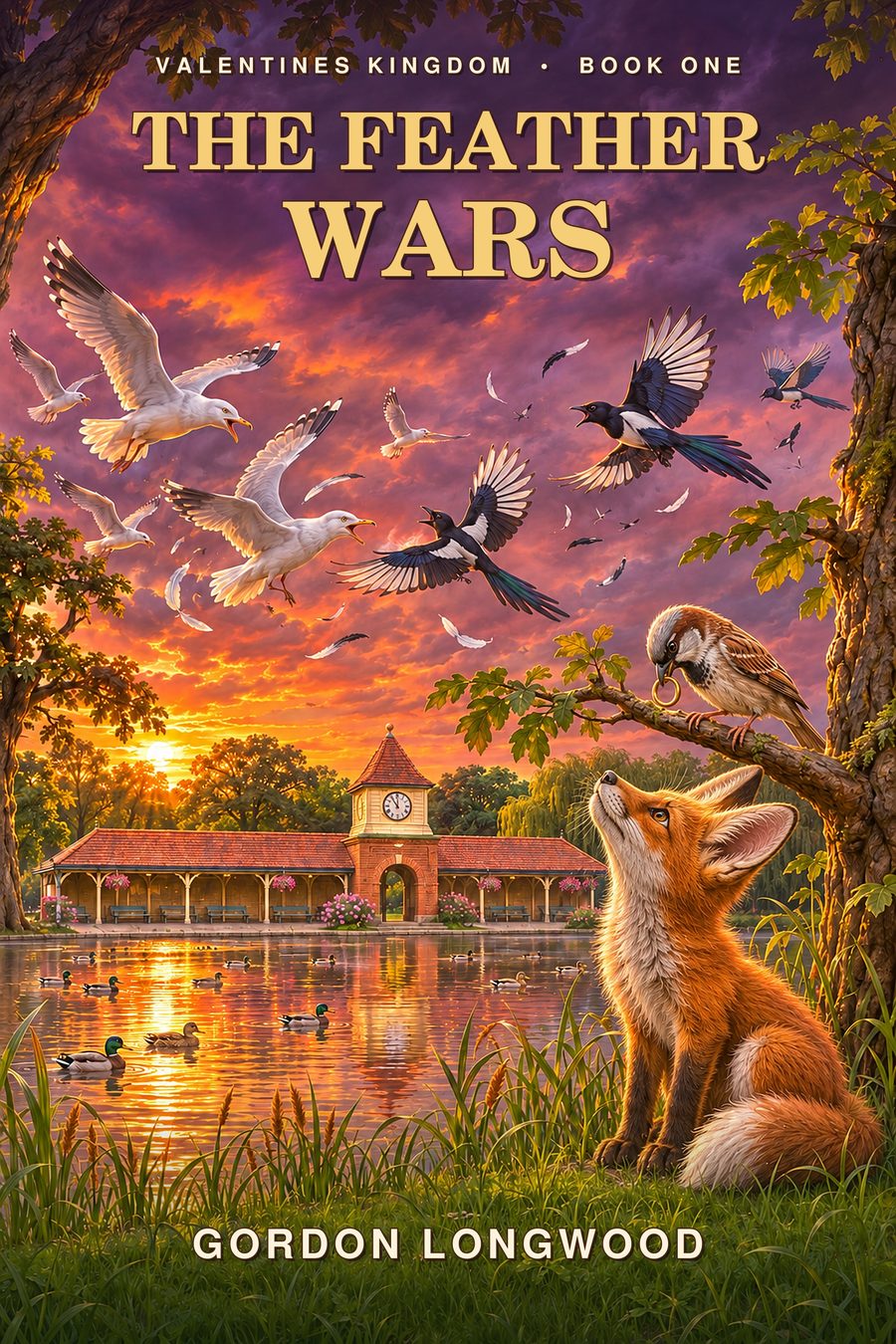
The Feather Wars
A mystery, a war and an unlikely friendship in a real London park.
The lake has gone. And in the mud, a small sparrow finds a ring with a single feather on it.
Pip has spent his whole life being overlooked. But when the gulls and the magpies of Valentines Park go to war, and every creature blames the foxes, Pip starts noticing things nobody else can see: tiny footprints, chewed fish, and a promise that was broken long before his nan was hatched.
With a fox for a friend, a wren who won’t stop shouting and a crow with secrets of his own, Pip must find the truth before the whole park tears itself apart.
- Ages 9–13
- 20 chapters
- Pencil illustrations throughout
- Valentines Kingdom, Book One
“The book was full of exciting adventures and interesting events that made me not want to stop reading.”Zaara, aged 12
“A book about friendship and betrayal. Starts off with a simple mystery but turns out to be a bigger adventure.”Zeenat I., early reader
Read the opening
The Water That Vanished
The lake had gone.
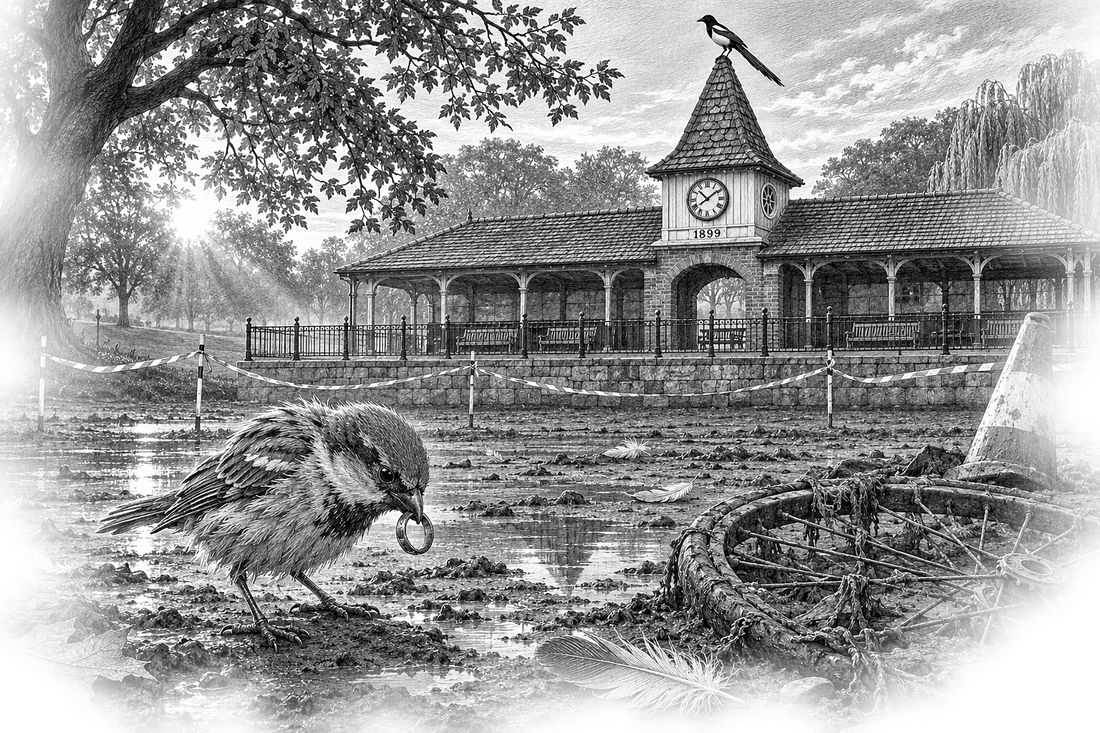
Not all of it. Pip wasn't daft. But when he poked his head out of the eaves above the clock-tower shelter that morning, still picking yesterday's chip salt out of his feathers, the water had pulled back from the bank as if it had taken offence at something in the night.
Where there should have been ripples, there was mud.
Grey, shining, smelly mud, stretching out from the stone edge in a long, wet grin. It ran the whole length of the shore, past the boat jetty, past the willows, all the way up to the far end, where the island sat in the water like a fat green hat.
Pip blinked. He blinked again, in case the first blink hadn't worked properly.
"Mum," he said. "Mum. Mum. Mum."
"I heard you the first time," said his mother, from somewhere underneath a heap of his brothers and sisters.
"The lake's gone."
"Lakes don't go, Pip."
"This one has. Well, half of it. A lot of it. It's gone a lot."
There was a grumble from the nest, then a squawk as somebody sat on somebody else, and then nothing. Nobody came to look. That was how it was when you had eleven brothers and sisters. In a family that size you could vanish for a whole afternoon and nobody would count you missing until tea.
Pip didn't mind. Mostly he didn't mind. Being unnoticed was what sparrows were good at. Nan Tuppence, who was the oldest sparrow on the west shore and had seen more winters than any sparrow had a right to, said it was their secret weapon.
"Gulls are big," Nan always said. "Magpies are clever. Crows are frightening. But nobody looks twice at a sparrow, and that's how we're still here. Small is quick, and quick is alive."
He hopped to the edge of the gutter, dropped onto the railings below and had a proper look.
The clock on the tower above him said ten to six. The sun hadn't climbed over the trees on the far side yet, so the whole lake lay in a cool blue shadow, and the mud gleamed like the inside of a mussel shell. And it was full of things.
There was a shopping trolley lying on its side with weed hanging from it like green hair. There was a bike wheel, a traffic cone, a single trainer and a pink plastic spade. There was something that might once have been an umbrella. And there were feathers.
Hundreds of them. Thousands, maybe. Stuck into the mud at every angle, as if somebody had planted a garden of them. Long white feathers with grey tips. Short black feathers with a blue-green shine. Gull feathers and magpie feathers, all jumbled together, as if the lake had been quietly keeping every feather from every fight for years and years, and had decided this morning to show everybody.
Pip felt a little shiver go down his back that had nothing to do with the cold.
Everybody knew about the gulls and the magpies. The gulls owned the water. The magpies owned the trees and the walled gardens behind the mansion. And the two of them had been squabbling, scrapping, chasing and sulking at each other since before anyone's nan could remember. Nobody could tell you how it started. You just learned it, the way you learned that dogs were bad and chips were good. Gulls and magpies hate each other. That's how it is. Keep your head down.
Pip kept his head down. He was good at it.
Along the grassy bank, somebody had pushed thin orange posts into the ground, a few wingspans apart, with red and white tape tied between them that fluttered and snapped in the breeze. Humans, obviously. Humans were always putting things in places and then taking them away again. Pip had stopped trying to understand humans a long time ago. As far as he was concerned, there were only three things worth knowing about them: chips were good, children dropped the most crumbs, and when a human said "Shoo!" you hopped away a little bit and then came straight back.
Down in what was left of the water, the ducks were having a meeting about it. Or rather, they were all talking at once, which for ducks was the same thing.
"Disgraceful," said one.
"Where's it gone? That's what I want to know. Where's it gone?"
"Somebody's drunk it."
"Who'd drink a whole lake?"
"Gulls," said a fourth duck darkly. "Gulls'd drink anything."
"You can't drink a lake, Doris."
"You don't know what gulls can do. Nobody knows what gulls can do."
Pip grinned to himself. Everybody in the park called the ducks the Quackers. They knew everything about everyone and understood none of it, and they could turn a rumour into a fact faster than you could say "Doris".
As if the word gull had summoned them, three herring gulls came screaming in low over the water, so close that their wingtips nearly clipped the reeds. They wheeled over the mud, yellow eyes blazing, beaks open.
"WHO DID THIS?"
"WHERE'S OUR WATER?"
"It's them! It's the BLACKFEATHERS! They've nicked our LAKE!"
Pip flattened himself against the railing until he was the same shape as a bit of rust. The gulls swept past without a glance, shrieking all the way up the lake towards the island, to tell Captain Salt, probably. Captain Salt was the biggest, loudest, oldest gull on the lake, and Nan said his shout could knock a pigeon off a chimney at fifty paces.
When the gulls had gone, the park seemed quiet. Too quiet. Pip glanced up.
On the very top of the clock tower, on the little point of the roof where nobody ever sat because it was too high and too windy, a magpie was perched. Black and white, with a long tail that caught the light like oil on a puddle. It wasn't moving. It wasn't calling or preening or doing any of the things magpies usually did. It was just watching the mud. Watching it the way you'd watch a door you were expecting somebody to come through.
Pip didn't like that one bit.
He was about to scuttle back up to the gutter where it was safe, when the sun came over the trees.
It came all at once, the way it does in summer. One moment the lake was blue and shadowy, and the next a great wash of gold spilled across the mud. Every wet feather shone. The trolley sparkled. And a few hops out from the stone edge, half buried in a ridge of mud, something winked at him.
A small, bright, golden wink.
Pip stared at it.
The wink did not go away.
Now, there were a lot of rules in Nan Tuppence's head, and she had given most of them to Pip whether he wanted them or not. One of the most important was: Never go anywhere you can't fly out of fast. And mud, Pip was fairly sure, was exactly that sort of place. Mud was sticky. Mud grabbed your feet. Mud was where small birds got stuck and then got eaten.
But that was the other thing about Pip. He noticed things. Tiny things. The crumb under the bin that everyone else missed. The loose brick in the shelter wall. The way a cat's tail flicked just before it pounced. And once Pip had noticed something, it sat in his head like a seed stuck in his throat, and he couldn't get rid of it until he'd dealt with it.
He looked left. He looked right. Nobody was looking at Pip. Nobody ever was.
He dropped off the railing onto the mud.
Plip.
His feet sank in up to the knees. It was cold, and it squeezed. He pulled one foot out with a squelch, then the other.
Plip. Squelch. Plip. Squelch.
Up close, the mud smelled of iron and rotting leaves and old copper coins, and underneath all that was another smell, sharp and sour, that made the feathers on the back of his neck prickle. Pip didn't know what it was. He didn't want to know.
And there were marks in the mud. Not bird marks. Pip knew bird marks: three toes forward, one toe back, like a little arrow. These were different. They were small, neat prints like tiny hands, too many fingers for a bird, far too small for a fox, running in tidy lines from the water's edge and heading away up the lake, towards the far end where the brook came in.
Mice, Pip decided. Probably mice. Mice didn't matter.
He had more important things to think about. He had reached the wink.
It was a ring.
Pip tugged it free with his beak, and the mud gave it up with a rude sucking noise. He dropped it on a flat bit of stone and looked at it properly.
It was no bigger than a blackberry, and it was made of an old yellow metal that had gone green at the edges, the colour of a pond in August. It was smooth on the inside, as if something had worn it. And on the outside, scratched very small and carefully into the metal, was the shape of a single feather.
Pip had seen plenty of shiny things in his life: bottle tops, ring-pulls, once a tiny silver key. This wasn't like any of those. This ring felt old. Not old like a crisp packet that had been in a hedge since spring. Old like the great trees by the mansion. Old like the bricks of the clock tower. Old like something that had been waiting.
Somebody made this, Pip thought. Somebody made this on purpose, with a feather on it, and put it somewhere safe. And then they lost it. Or hid it.
"Huh," said Pip, out loud.
The sun went behind something.
Not a cloud. Clouds don't have tails.
Pip looked up. The magpie from the clock tower was gliding down towards him in a long, lazy curve, black wings spread wide, eyes fixed not on Pip but on the ring.
"Well, well," it said. Its voice was soft and smooth, the voice of somebody who was always pleased with themselves. "That's a very pretty thing for a nobody to be holding."
Pip snatched up the ring in his beak.
"I'll take that," said the magpie, landing on the stone edge right in front of him. Up close, it was enormous, at least five sparrows long, and its beak was sharp enough to open a crisp packet in one go. "Magpie business, that is. Shiny things are magpie business. Everyone knows that."
"Mmf," said Pip, which was all he could manage with a ring in his mouth.
"What was that?"
"Mmf-mmf."
The magpie leaned closer. "Drop it, little sparrow, and nobody gets hurt."
Small is quick, said Nan Tuppence in his head, and quick is alive.
Pip ran.
Not up. That was what the magpie would expect, and up was open sky where a magpie could catch a sparrow in two flaps. Pip ran sideways, low and fast, wings whirring, feet barely touching the mud, straight towards the boat jetty, where the rowing boats were tied up nose to tail, bumping gently against each other.
The magpie swore a word that Nan would have washed his beak out for, and came after him.
Pip shot under the first boat. It was dark under there and smelled of wet wood and weed. He zipped through the gap between two hulls, a gap so narrow his wings brushed the paint on both sides. Behind him came a thump and a squawk as the magpie tried to follow and didn't fit.
Pip burst out from under the last boat, straight into the middle of the Quackers.
Six ducks looked up at once.
"EXCUSE ME," said Doris.
"Sorry!" said Pip, except that it came out as "Mmf!", and he dived between Doris's feet.
A heartbeat later, the magpie came over the top of the boats at full speed, saw a sparrow vanishing into a crowd of ducks, swerved, and crashed straight into the biggest duck of all.
There was an explosion of feathers. Black ones, white ones and brown ones went everywhere. The ducks went up like a firework, quacking with outrage, flapping and splashing and shouting all at once.
"ASSAULT!"
"In broad daylight!"
"I'm telling the swans! I'm telling the SWANS!"
Nobody in the park argued with the swans. They lived at the far end of the lake among the reeds and hardly ever spoke to anyone. But Nan said that in her whole long life she had seen them rise into the air together only twice, and both times every bird in the park had gone quiet.
By the time the feathers had settled, the magpie was sitting in the shallow water looking wet and very cross, with a piece of weed draped over its head like a hat. And Pip had gone.
He had flown low along the bank, under the fluttering tape, past the orange posts, and back to the clock tower, where he squeezed himself into a little gap in the brickwork at the bottom of the tower, a gap he had found when he was a fledgling and had never told anybody about. He pressed himself in as far as he would go and lay there, panting, with the ring still in his beak and his heart going like a rain shower on a tin roof.
He listened.
Out on the water, the ducks were still complaining. After a while he heard heavy wingbeats and saw, through the gap, the magpie flying off low and fast across the grass, away from the lake, towards the trees and the high brick walls of the gardens behind the mansion.
Going to tell somebody, Pip thought. Going to tell somebody important.
He waited until he couldn't hear the wings any more. Then he carefully put the ring down on the dusty brick in front of him and looked at it again.
The feather on it caught the thin light coming through the gap and seemed, for a moment, almost to glow.
He should tell Mum. But Mum would say put it back where you found it, Pip, we don't want trouble. He should tell Nan Tuppence. But Nan would look at it and then say something wise and annoying that he wouldn't understand until he was much older.
Or...
Or he could keep it. Just for a little while. Because for the first time in his whole small, quick, unnoticed life, Pip had found something that nobody else had found. Not the gulls. Not the magpies. Not anyone.
For once, something had happened to him.
He was smiling at that thought, a small secret smile, when a shadow fell across the gap in the bricks.
It wasn't magpie-shaped. It was bigger. Darker. Black from beak to tail, without a single white feather anywhere.
Pip edged forward, very slowly, and peered up.
On the edge of the shelter roof, just above his hiding place, sat a crow.
Not just any crow. Every bird in Valentines Park knew this crow, though hardly any of them had ever spoken to him. He lived alone in a dead tree near the old dovecote and never came down to the water. He didn't join the gulls or the magpies. He didn't join anybody. The young sparrows dared each other to fly past his branch, and the old ones said he had been in the park longer than the clock. Nobody knew where he had come from, or what he wanted.
His name was Corvin.
His feathers were so black they looked blue at the edges. His beak was heavy and grey, like a tool for opening things. And his eyes, dark and steady and very, very clever, were not looking at Pip at all.
They were looking at the ring.
Corvin had gone completely still. Not the comfortable stillness of a bird resting. It was the stillness of a cat the moment before it jumps, or of somebody who has just seen a face they thought they would never see again.
"Put it down," said Corvin quietly. "Slowly."
Pip realised he had picked the ring up again without meaning to. He put it down. Very slowly.
The crow's eyes moved, at last, from the ring to Pip. And Pip, who had spent his whole life wishing that just once somebody would look at him properly, discovered that being looked at properly was not nearly as nice as he had always imagined.
"Now," said Corvin, "tell me exactly where you found it."
The story continues in The Feather Wars, coming early 2027.